WHAT IS NEET? COMPLETE GUIDE TO ELIGIBILITY, COURSES, EXAM PATTERN, SYLLABUS AND COUNSELLING
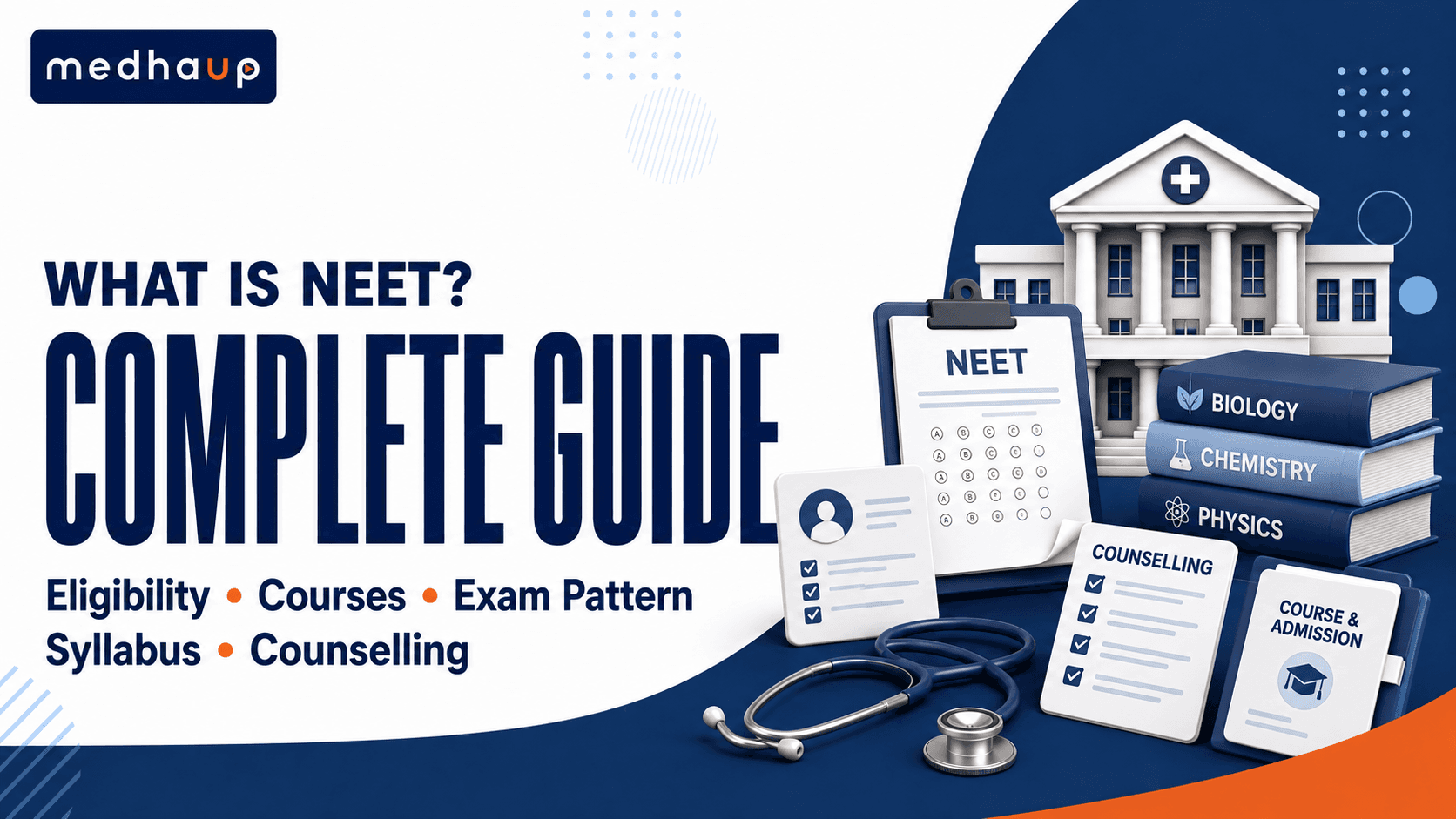
WHAT IS NEET? COMPLETE GUIDE TO ELIGIBILITY, COURSES, EXAM PATTERN, SYLLABUS AND COUNSELLING
SEO Title: What Is NEET? Full Form, Eligibility, Exam Pattern, Courses and Counselling
Meta Description: Learn what NEET-UG is, who can apply, courses covered, eligibility, exam pattern, marking scheme, syllabus, qualifying percentile and counselling process.
NEET is India’s common medical entrance examination for students who want to pursue undergraduate medical education. It is one of the country’s largest and most competitive entrance examinations.
The term NEET usually refers to NEET-UG, which students take after Class 12 for admission to courses such as MBBS and BDS. Separate examinations—NEET-PG and NEET-SS—are conducted for postgraduate and super-speciality medical education.
NEET FULL FORM
NEET stands for National Eligibility-cum-Entrance Test.
• NEET-UG: For undergraduate medical education • NEET-PG: For postgraduate courses such as MD and MS • NEET-SS: For super-speciality courses such as DM and MCh
When school students and parents use the word “NEET”, they generally mean NEET-UG.
WHAT IS NEET-UG?
NEET-UG is a common national entrance examination for admission to undergraduate medical education in India. It is conducted by the National Testing Agency or NTA.
NEET scores are accepted by government medical colleges, private medical colleges, deemed universities, AIIMS, JIPMER and other participating institutions across India.
After the examination, candidates receive:
• NEET score • Percentile score • All India Rank or AIR • Category rank, wherever applicable • Qualifying status
NEET is an entrance examination, not a course. Simply qualifying NEET does not guarantee an MBBS or medical seat. Admission depends on the candidate’s rank, category, domicile, college preferences, seat availability and counselling results.
WHICH COURSES REQUIRE NEET?
NEET-UG is primarily required for admission to:
• MBBS — Bachelor of Medicine and Bachelor of Surgery • BDS — Bachelor of Dental Surgery • BAMS — Bachelor of Ayurvedic Medicine and Surgery • BUMS — Bachelor of Unani Medicine and Surgery • BSMS — Bachelor of Siddha Medicine and Surgery • BHMS — Bachelor of Homoeopathic Medicine and Surgery
NEET scores may also be used for:
• Military Nursing Service B.Sc Nursing admission • Certain B.Sc Nursing programmes where NEET is accepted • BVSc and AH admission under the applicable Veterinary Council quota • Other courses or institutions that officially decide to use NEET scores
NEET is not compulsory for every nursing or allied-health course. Candidates must check the eligibility rules of the particular institution or counselling authority.
WHO CONDUCTS NEET?
Different organisations perform different responsibilities:
National Testing Agency (NTA): Conducts registration, examination, answer-key publication, result declaration and All India Rank preparation.
National Medical Commission (NMC): Regulates medical education and publishes the official NEET-UG syllabus.
Medical Counselling Committee (MCC): Conducts counselling for 15% All India Quota seats and specified central, AIIMS, JIPMER and deemed-university seats.
State Counselling Authorities: Conduct counselling for state quota and other seats controlled by the respective state.
AACCC: Conducts All India counselling for AYUSH courses such as BAMS, BUMS, BSMS and BHMS.
NEET-UG ELIGIBILITY CRITERIA
Minimum Age
A candidate must complete 17 years of age on or before 31 December of the year in which the NEET examination is taken.
Upper Age Limit
Under the current official rules, there is no upper age limit for appearing in NEET-UG.
Educational Qualification
Candidates should have passed or be appearing in a recognised Class 12 or equivalent examination with:
• Physics • Chemistry • Biology or Biotechnology • English • Required practical examinations, wherever applicable
Students awaiting their Class 12 results may appear provisionally. However, they must pass the qualifying examination with the required subjects before admission or the applicable counselling stage.
Candidates who study Physics, Chemistry, Biology/Biotechnology and English as additional subjects after passing Class 12 may also be eligible, provided they produce valid documentary evidence from a recognised board.
NRI, OCI and foreign-national candidates may apply subject to the admission rules of the relevant government, institution and counselling authority.
NEET-UG EXAM PATTERN
According to the official NEET-UG 2026 pattern:
Physics: 45 questions carrying 180 marks Chemistry: 45 questions carrying 180 marks Biology—Botany and Zoology: 90 questions carrying 360 marks
Total Questions: 180 Total Marks: 720 Standard Duration: 3 hours Examination Mode: Pen and paper using an OMR answer sheet Question Type: Multiple-choice questions Frequency: Generally once a year
All 180 questions are compulsory.
NEET MARKING SCHEME
• Correct answer: +4 marks • Incorrect answer: −1 mark • Unanswered question: 0 marks
Example:
If a student answers 150 questions correctly, 20 incorrectly and leaves 10 unanswered:
Score = (150 × 4) − (20 × 1) Score = 600 − 20 Final Score = 580 marks
Since NEET has negative marking, accuracy is extremely important. Unnecessary guessing can reduce the final score.
NEET-UG LANGUAGES
NEET-UG 2026 was offered in 13 languages:
• English • Hindi • Assamese • Bengali • Gujarati • Kannada • Malayalam • Marathi • Odia • Punjabi • Tamil • Telugu • Urdu
Candidates selecting Bengali or another regional language generally receive a bilingual question paper containing English and the selected regional language.
If there is any ambiguity or translation-related difference, the English version of the question is treated as final.
NEET SYLLABUS
The NEET syllabus covers Physics, Chemistry and Biology from the higher-secondary level. The National Medical Commission publishes the official syllabus for every examination cycle.
PHYSICS
Important areas include:
• Units and measurements • Kinematics • Laws of motion • Work, energy and power • Gravitation • Rotational motion • Properties of matter • Thermodynamics • Oscillations and waves • Electrostatics • Current electricity • Magnetism • Electromagnetic induction • Optics • Atoms and nuclei • Electronic devices
CHEMISTRY
The syllabus includes:
• Physical Chemistry • Inorganic Chemistry • Organic Chemistry • Atomic structure • Chemical bonding • Thermodynamics • Equilibrium • Solutions • Electrochemistry • Periodicity • Coordination compounds • Hydrocarbons • Organic functional groups • Biomolecules • Principles of practical chemistry
BIOLOGY
The Biology section includes Botany and Zoology topics such as:
• Diversity in the living world • Structural organisation in plants and animals • Cell structure and function • Plant physiology • Human physiology • Reproduction • Genetics and evolution • Biology and human welfare • Biotechnology • Ecology and environment
Students should always follow the latest official NMC syllabus instead of relying entirely on old or unofficial syllabus lists.
NEET QUALIFYING PERCENTILE
The minimum qualifying percentiles are:
General and General-EWS: 50th percentile SC, ST and OBC-NCL: 40th percentile Unreserved and General-EWS PwBD: 45th percentile SC, ST and OBC-NCL PwBD: 40th percentile
Percentile and percentage of marks are not the same.
Percentage shows how many marks a candidate obtained out of 720. Percentile indicates the candidate’s relative performance compared with other students.
The marks corresponding to the qualifying percentile change every year.
QUALIFYING CUT-OFF VS ADMISSION CUT-OFF
Qualifying Cut-off
This is the minimum score or percentile required to qualify NEET and participate in eligible counselling.
Admission Cut-off
This is the rank or score at which admission to a particular college, course and category closes during counselling.
The admission cut-off for a government medical college is generally much higher than the basic NEET qualifying cut-off.
HOW DOES NEET COUNSELLING WORK?
The usual NEET counselling process includes:
- Online counselling registration
- Payment of registration fee and security deposit, where applicable
- College and course choice filling
- Choice locking
- Seat allotment result
- Acceptance of the allotted seat
- Reporting to the allotted college
- Physical document verification
- Payment of admission fees
- Participation in further rounds or upgradation, if permitted
ALL INDIA QUOTA COUNSELLING
MCC conducts online counselling for the 15% All India Quota and specified seats in:
• AIIMS • JIPMER • Central universities • Deemed universities • ESIC institutions • Other participating central institutions
STATE COUNSELLING
State authorities conduct counselling for state-controlled seats, commonly including the 85% state quota.
Domicile, reservation, category and private-college admission rules differ between states. Candidates may need to register separately for MCC counselling and their respective state counselling.
RESERVATION IN MCC COUNSELLING
For applicable All India Quota and central-institution seats:
• SC: 15% • ST: 7.5% • OBC-NCL: 27% • General-EWS: 10% • PwBD: 5% horizontal reservation
Reservation for state quota seats follows the rules of the respective state government.
NEET APPLICATION PROCESS
The standard application process includes:
- Visit the official NEET website.
- Complete new candidate registration.
- Fill in personal, contact, identity and academic details.
- Select the examination language and preferred examination cities.
- Upload the required photograph, signature and documents.
- Pay the examination fee online.
- Download the confirmation page and payment receipt.
The examination fee and application dates change annually.
As a reference, the NEET-UG 2026 application fees in India were:
• General: ₹1,700 • General-EWS/OBC-NCL: ₹1,600 • SC/ST/PwBD/PwD/Third Gender: ₹1,000 • Candidates applying from outside India: ₹9,500
DOCUMENTS COMMONLY REQUIRED
• Recent passport-size photograph • Postcard-size photograph, if prescribed • Scanned signature • Class 10 certificate for date-of-birth verification • Class 12 or qualifying-examination details • Government identity document • Category certificate, if applicable • PwD/PwBD certificate, if applicable • NRI, OCI, citizenship or foreign-national documents, where applicable
Candidates must follow the document format and size mentioned in the official information bulletin.
HOW TO PREPARE FOR NEET
Build Strong Concepts
Understand the concepts before solving large numbers of questions. Physics requires conceptual clarity and numerical practice. Chemistry requires theory, calculations and reaction revision. Biology requires accurate understanding and repeated revision.
Follow NCERT Books
NCERT textbooks are extremely important, especially for Biology and Chemistry. Read every chapter carefully and revise diagrams, tables, examples and important lines.
Practise MCQs
Solve chapter-wise MCQs, previous-year questions and full-length mock tests regularly.
Practise OMR Sheets
Since NEET is conducted in pen-and-paper mode, practise filling OMR sheets accurately. A bubbling mistake can affect the final score.
Analyse Mock Tests
After every mock test, identify:
• Conceptual mistakes • Calculation mistakes • Memory gaps • Questions you misread • Time-management problems • Unnecessary guessing
The purpose of a mock test is not only to check marks but also to understand and correct mistakes.
COMMON MYTHS ABOUT NEET
“Qualifying NEET guarantees an MBBS seat.”
False. Qualifying NEET only makes a candidate eligible for counselling. Admission depends on rank, category, choices and seat availability.
“NEET is only for government colleges.”
False. NEET is used for admission to government, private, deemed and central medical institutions.
“NEET is only for MBBS.”
False. NEET is also used for BDS, AYUSH and certain other officially notified programmes.
“NEET percentile and percentage are the same.”
False. Percentage represents marks scored out of 720, whereas percentile represents a candidate’s performance relative to other candidates.
NEET-UG, NEET-PG AND NEET-SS DIFFERENCE
NEET-UG: For students seeking undergraduate medical admission to courses such as MBBS, BDS and AYUSH.
NEET-PG: For medical graduates seeking postgraduate admission to courses such as MD and MS.
NEET-SS: For postgraduate doctors seeking admission to super-speciality courses such as DM and MCh.
OFFICIAL WEBSITES
NEET-UG: https://neet.nta.nic.in/
National Testing Agency: https://nta.ac.in/
National Medical Commission: https://www.nmc.org.in/
Medical Counselling Committee: https://mcc.nic.in/
AYUSH Counselling: https://aaccc.gov.in/
FINAL WORDS
NEET-UG is the primary entrance examination for students who want to pursue medical education after Class 12. Success requires strong fundamentals in Physics, Chemistry and Biology, consistent revision, extensive MCQ practice, OMR-sheet accuracy and careful counselling decisions.
Students should always verify the latest eligibility rules, examination dates, fees, syllabus and counselling schedule from official sources because NEET regulations can change.
Disclaimer: This article is intended for educational guidance. The official NTA information bulletin, NMC regulations and counselling notifications issued for the relevant academic year will be considered final.
Follow medhaup for NEET preparation guidance, Biology concept classes, chapter-wise MCQs, mock tests and counselling updates.
Have a question about your preparation?
Message us on WhatsApp — Bengali or English, we reply the same day.
Chat on WhatsApp